

What Is a Must-Drop Jackpot and How Does It Work?
A must-drop jackpot is a pool that grows until it is forced to fall. The mechanic teaches players something important about probability and timing, though not always what the operators intended.
Filed 23 April 2026 · 3 min read
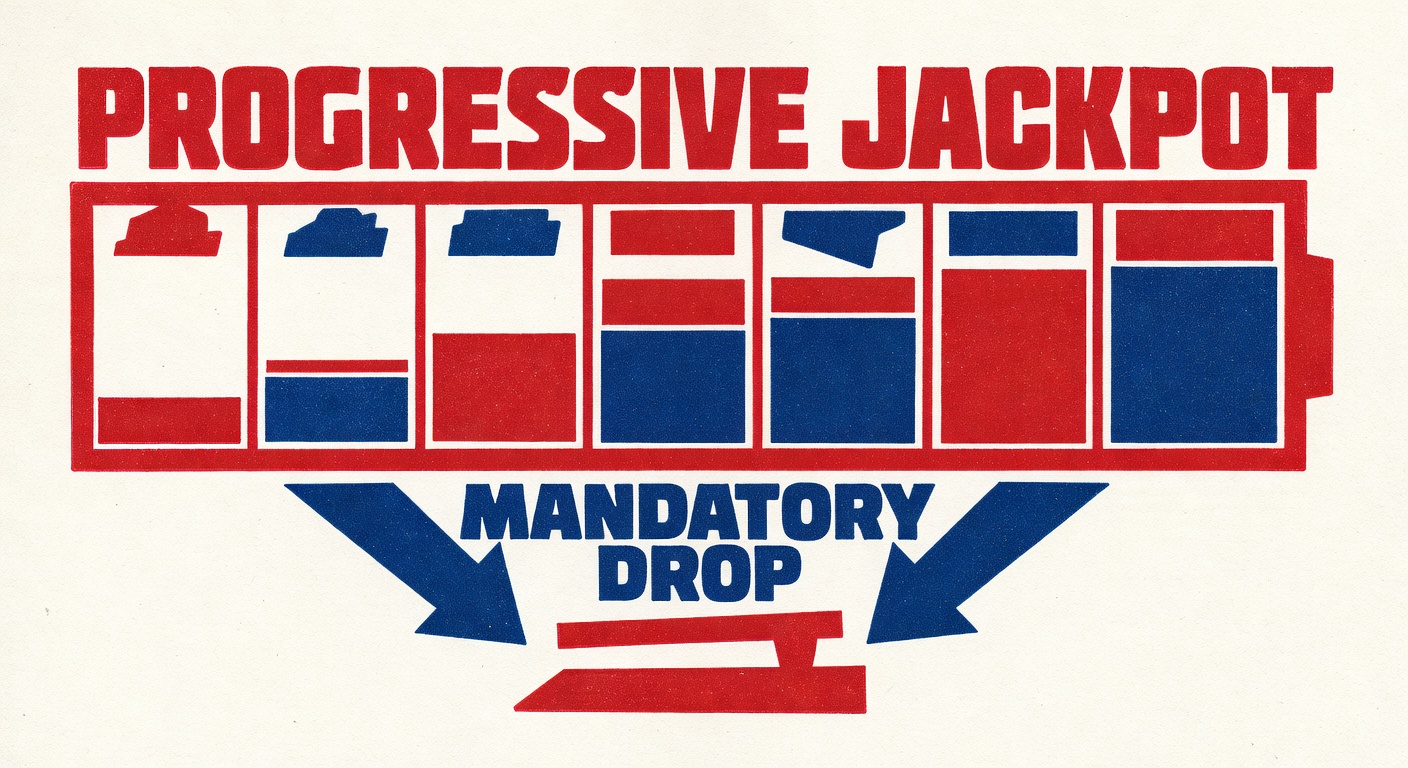
A must-drop jackpot is a progressive pool that accumulates day by day, hand by hand, or spin by spin, and carries a built-in guarantee: it must pay out by a certain date, at a certain metric of play, or according to some other mechanical constraint. If no player has naturally hit the jackpot by that deadline, the house begins paying it down through regular play until someone wins. The format combines two powerful behavioral forces: progressive hope and progressive scarcity.
How the Mechanics Work
The structure is simple. At Stake or Bet365's live poker rooms, a progressive poker jackpot might start at $10,000 and grow by $50 per hour the room is active. By day thirty, if no one has hit it, the system begins a forced payout sequence: $200 per hitting hand, $500 per set, $2,000 per royal flush. By day thirty-five, those payouts double. By day forty, the room begins paying the entire remainder into the next natural big hand regardless of hand strength.
The point is not fairness. The point is turnover. A $400,000 pool sitting untouched for a month kills the psychological engine of the room. Players stop hoping. Players lose the sense that this is a game they can win by accident. A must-drop mechanic restores urgency.
What This Does to Perception
Psychologically, a must-drop jackpot creates two opposing forces: hope and scarcity. Early in the cycle, players think "this might grow huge, I should stay." Midway through, they think "this is big and it has to hit, I should stay." Late in the cycle, they think "someone will win this soon and I should be at the table when they do." Each phase activates a different neural pathway.
This is not manipulation, exactly. This is design informed by how human beings actually perceive time and probability. A jackpot that grows indefinitely with no resolution date creates a different emotional texture than one with a visible endpoint. The must-drop structure makes the endpoint visible.
The Reinforcement Schedule
Must-drop jackpots are variable-ratio reinforcers. You do not know which hand will trigger the payout, but you know the payout is coming. This is exactly the schedule that produces the strongest behavioral conditioning. Slot machines use this principle. Poker rooms use this principle. The animal research goes back decades: variable-ratio schedules produce higher response rates than fixed-ratio schedules and higher resistance to extinction.
Players at the poker table do not think "I am being exposed to a variable-ratio reinforcement schedule optimized to maximize my play frequency." They think "I should stay for one more hand." Both things are true.
The House Edge
The must-drop jackpot does not change the house rake or the game's mathematical structure. It is a draw mechanism layered on top of the game. Pragmatic Play uses must-drop mechanics in their live baccarat offerings. Evolution Gaming's Three Card Poker tables have them. The underlying game odds remain unchanged. The bet you make against the dealer is the same math it always was. The jackpot is an ancillary mechanism.
Where the house wins is in player retention and play frequency. A player who wins a $30,000 must-drop jackpot on a Wednesday has now had a significant life event in the poker room. They are more likely to return. They are more likely to tell other players. The mathematical cost of the jackpot pool is recovered through turnover.
What It Teaches
A must-drop jackpot teaches something true: in games of chance, the longer you play, the higher the probability you will hit something. It teaches something false: that being present at the moment of inevitability is a strategy. The first lesson is accurate and useful. The second lesson is dangerous. Players conflate presence with agency. They think staying late increases their odds when really it just increases their play.
This is not a flaw in the mechanic. It is the entire point. The structure works because players misunderstand it in profitable directions.