

How Much Is a Queen in Blackjack? Ten, and Why It Matters
A queen counts 10 under New Jersey and Washington rules. Here is how that value shapes blackjack payouts, splitting a queen and king, and doubling.
Filed · 4 min read
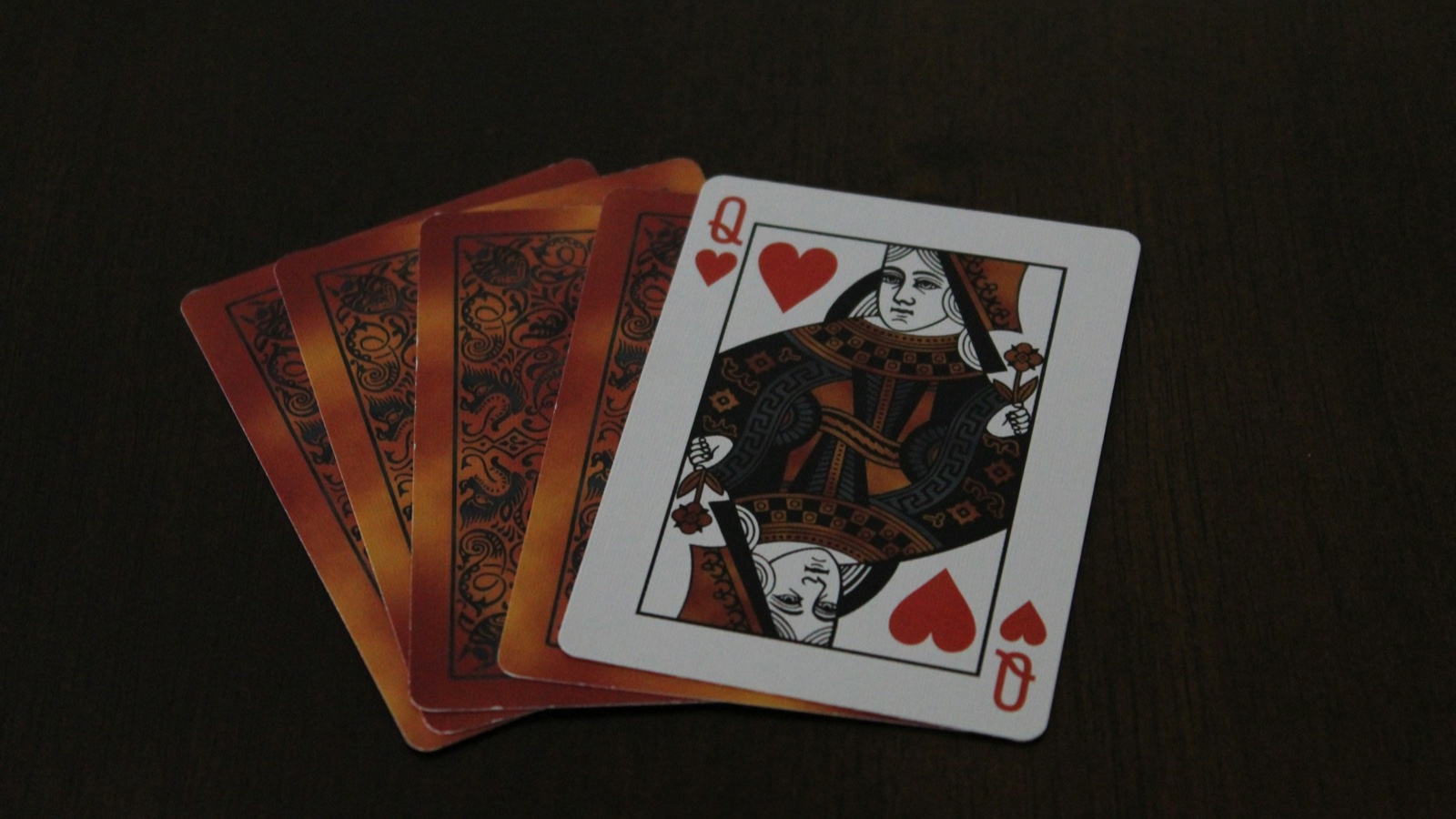
Photo: Laine Cooper on Unsplash
A queen is worth 10 in blackjack. New Jersey's casino code says any Jack, Queen or King counts 10, and Washington's commission puts it the same way: picture cards are valued at 10. The suit on the card adds nothing.
That single figure does more work than it seems.
Face cards: what the jack, queen and king are worth
Jacks, queens and kings all count 10, the same as the 10 itself. Washington's rulebook, revised as of April 2018, adds that suits carry no value at all, so a queen of hearts and a queen of spades play identically.
How much is an ace worth in blackjack
An ace counts 11 unless that would push the hand past 21, and then it counts one. That is New Jersey's wording on the ace, and Washington's version says simply that aces count 1 or 11.
The ace is the only card with two values, and it is the queen's natural partner. An ace beside a queen makes 21 in two cards: a blackjack.
Hard hands, soft hands and the queen
A hand is hard when no ace in it is counted as 11, and soft when one is. A queen paired with a six is a hard 16; an ace with a six is a soft 17 that can take another card without busting.
The distinction is more than vocabulary. New Jersey lets a casino restrict doubling to hard nine, 10 or 11 under its notice rules, so a soft hand or a higher total may be shut out of a double on some tables. The same section bars doubling a two-card 21.
When a queen meets a king: splitting tens
In New Jersey the test for a pair is value, not rank. The code lets a player split when the first two cards match in value, which means a queen and a king, or a queen and a 10, qualify as a pair of tens.
Aces are the exception that the code singles out: split aces receive one card each and no more. A split queen faces no such cap under that rule.
The queen showing on the dealer's side
A queen as the dealer's upcard changes how a player blackjack gets paid. Under New Jersey's code, when the dealer shows a ten-value card or an ace, payment waits for the dealer's second card; if that card makes a dealer blackjack, the player's blackjack is a stand off, otherwise it pays 3 to 2.
Massachusetts writes the same trigger into its rules, current as of April 2026: the delay applies when the dealer's first upcard is ten-valued or an ace and a player holds blackjack. Against a dealer two through nine, New Jersey has the player blackjack paid immediately at 3 to 2.
How many queens are in the shoe
Each queen belongs to a standard 52-card deck, and Washington permits up to eight 52-card decks. New Jersey ties the deck count to the side bets offered, requiring six or eight decks with match-the-dealer or the optional bonus wager. The full deck rules are covered in our story on how many decks in blackjack.
| Card | Value | Rule source |
|---|---|---|
| Queen, King, Jack | 10 | New Jersey, Washington |
| 10 | 10 | New Jersey |
| Ace | 11, or one if 11 would bust | New Jersey, Washington |
Letters: your questions
Is 21 a win in blackjack?
A two-card 21 is a blackjack, and against a dealer showing two through nine New Jersey has it paid at once at 3 to 2. Against a dealer ace or ten-value card the payment waits, and a dealer blackjack turns it into a stand off rather than a win.
Should I double down on a 12?
You may not get the chance. New Jersey lets a casino limit doubling to a hard nine, 10 or 11 under its notice rules, and a 12 is outside that range wherever the limit applies.
What to never split in blackjack?
The rules forbid no pair of equal value, so a queen and a king can be split. What the rules do cap is aces: under New Jersey's code split aces draw one card each and nothing more. Splitting two ten-value cards also breaks up a 20, a decision for strategy rather than the rulebook.
Sources for this story
- New Jersey Division of Gaming Enforcement (text via Cornell LII): N.J. Admin. Code 13:69F-2.2 Cards; number of decks; value of cards, accessed October 2026
- New Jersey Division of Gaming Enforcement (text via Cornell LII): N.J. Admin. Code 13:69F-2.11 Splitting pairs, accessed October 2026
- New Jersey Division of Gaming Enforcement (text via Cornell LII): N.J. Admin. Code 13:69F-2.7 Blackjack, accessed October 2026
- New Jersey Division of Gaming Enforcement (text via Cornell LII): N.J. Admin. Code 13:69F-2.10 Doubling down, accessed October 2026
- Washington State Gambling Commission: Blackjack Game Rules (revised April 2018), April 2018
- Massachusetts Gaming Commission: Blackjack rules (205 CMR 147), April 9, 2026
Filed under: Blackjack
Also in this edition
How Many Decks in Blackjack: What the Rules and Odds Say
New Jersey and Pennsylvania rules set blackjack's deck minimums, and each extra deck lifts the house edge, from 0.014% at one deck to 0.577% at eight.
16 October 2026
Flash Cards and Apps for Memorizing Basic Strategy
You sit in a bar at midnight with your phone, memorizing when to hit and when to stand. The city doesn't care. Neither does the casino.
10 September 2026
Why Single Deck Blackjack Isn't Always the Better Choice
A young man sits across from a dealer, chasing the myth that one deck beats six.
8 September 2026
The Kelly Criterion at Blackjack: When a Mathematician Sized Bets Like a Professional
One evening in the late 1980s, an industrialist from Hamburg arrived at a Monte Carlo high-limit room with a leather portfolio and no expression.
11 August 2026
Why Continuous Shuffling Machines Kill Most Advantage Plays
The Nevada Gaming Commission first regulated continuous shuffling devices in 1986, but casinos did not widely adopt them until the late 1990s, after MIT's blackjack card-counting team made headlines in 2008 following the publication of Bringing Down the House.
10 August 2026
Why Free Play Blackjack Can Create Bad Habits
The Bellagio's training room smells like stale coffee and plastic cards.
31 July 2026