

The Art of Slow Playing Big Hands in Poker
Slow playing a strong hand trades immediate value for the chance of extracting more later. Here's the economic calculation that determines when it works.
Filed 23 April 2026 · 3 min read
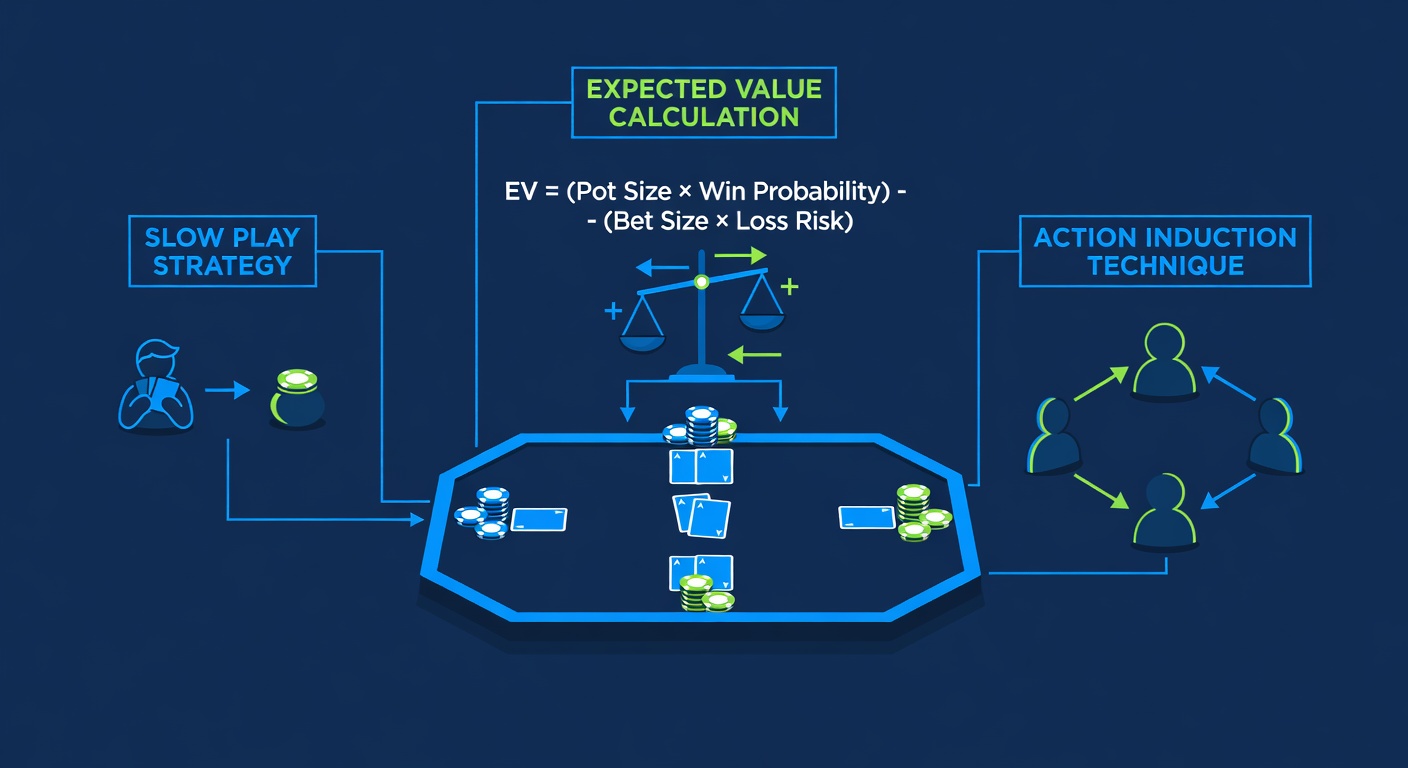
To slow play is to mask strength. The player holds a powerful hand but does not bet in proportion to its value. Instead, they call smaller bets, check to encourage aggression from opponents, or otherwise conceal the hand's quality. The purpose is to induce larger bets from opponents who would fold if they perceived the true strength of the position.
This is not a deception in the colloquial sense. All poker contains deception; every bet communicates something the player wants communicated. Slow play is specific: it sacrifices immediate value for the possibility of extracting greater future value. It is a trade-off between certainty now and uncertainty later.
The Economics of Slow Play
Consider a player holding pocket aces in Texas Hold'em. Aces are the strongest starting hand. A direct bet indicates strength and likely wins the pot immediately, perhaps extracting a single call. The player gains value now: they win some amount with high probability.
Alternatively, the player calls a smaller bet or checks. Opponents interpret this as weakness or a marginal hand. They may increase their betting in later streets, building a larger pot. If the aces hold and win, the total gain exceeds what a direct aggressive line would have yielded. The player traded certainty for size.
But trade-offs exist. If an opponent improves their hand in subsequent streets and wins, the player loses more than they would have lost with aggressive play earlier. The slow-played hand now yields a loss rather than a small gain. The expected value calculation must account for this possibility.
Marginal and Submarginal Conditions
Slow play has value only when specific conditions exist. The player's hand must be strong enough to win often but not so strong that it wins regardless of opponent action. Pocket aces are too strong for slow play in most situations; they win so frequently that extracting more value through inducement creates unnecessary variance without improving long-term expectations. Hands like a flopped set (three of a kind) on an active board are candidates because they are strong enough to win often but vulnerable to draws.
The opponent must be the kind of player who increases aggression when perceiving weakness. A passive player will not bet more into a checking slow-player. An observant opponent who correctly reads slow play as a trap will not fall for it. Slow play only functions against specific opponent profiles.
The pot must be small relative to the stack sizes. If the pot is already large, the player does not need additional value; they need to win the hand. If stack sizes are small, there is limited future value to extract through slow play.
The Variance Cost
An Austrian economist views this through the lens of time preference. Slow play is a bet on future states. The player prefers to extract value later rather than now. This has a cost: variance. The player who bets immediately reduces variance by winning the hand sooner. The player who slow-plays increases variance by allowing additional cards to fall and opponents to improve.
Long-term, if the player correctly identifies slow-play situations, the higher expected value compensates for the higher variance. In the short term, the slower line creates larger fluctuations. This is the discount rate problem. Some players have a high discount rate and prefer immediate certain value. Others discount the future less heavily and accept variance for larger expected value.
When Slow Play Fails
The entire strategy collapses if the opponent improves. A set on the flop appears strong until the river brings a straight or flush possibility that completes. The slow-player then holds second-best or worse, and the value extraction has become a loss. This is not a failure of slow play as a concept but a reminder that poker outcomes depend on cards yet to come.
Slow play is economically rational only when opponents are predictable, the player has correctly assessed hand strength, and stack sizes permit future value extraction. It is a calculated trade of present certainty for future possibility.