

Live Dragon Tiger: The Simplest Table Game You'll Ever Learn
Dragon Tiger emerged in Cambodia in the 1960s and became a staple of Asian casinos. The game appears in live form on contemporary online platforms, offering a stripped-down variant of baccarat with minimal complexity.
Filed 24 April 2026 · 4 min read
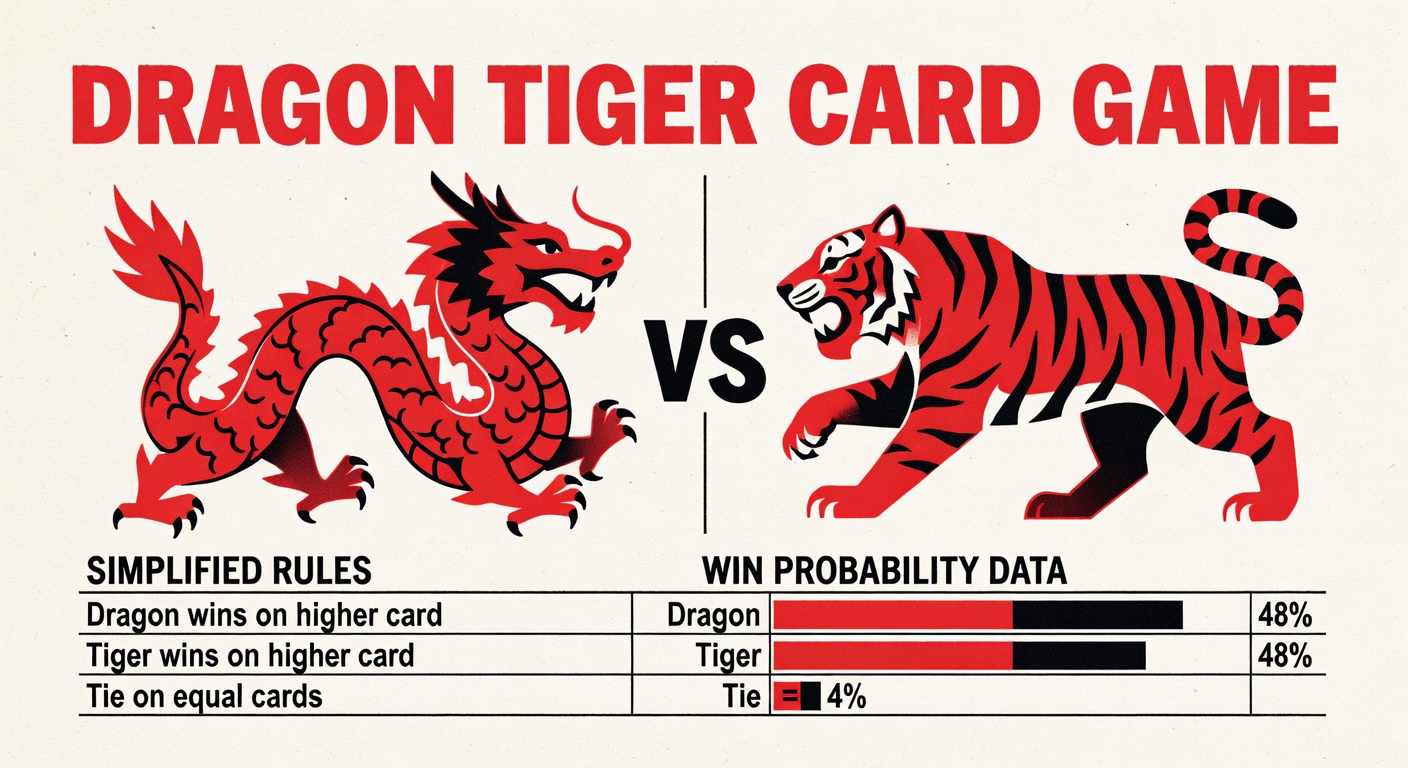
Dragon Tiger is a card game derived from baccarat, played with a standard deck of 52 cards. The game began as a regional variant in Southeast Asia, particularly in Cambodia, and spread to Malaysia and Vietnam during the 1960s and 1970s. It appeared in brick-and-mortar casinos throughout the region before being adapted to online and live dealer formats during the 2000s.
The game reached Western players through Asian-focused online casinos and later through mainstream gaming platforms acquiring live dealer capabilities. As of the early 2020s, Dragon Tiger is available at most casinos offering live table games, particularly those targeting Asian-diaspora players.
The Mechanics
Dragon Tiger requires no strategy. The game eliminates choice from baccarat by removing the option of a third card. One card is dealt to the Dragon position. One card is dealt to the Tiger position. The highest card wins. Aces are low; kings are high. That is the entirety of the game.
Baccarat, by contrast, involves a third card rule that determines whether the banker or player receives an additional card based on the total value of their first two cards. This rule complicates the game and introduces decisions, albeit limited ones. Dragon Tiger removes all of this. Each hand consists of exactly two cards dealt. The comparison is immediate. There is no third card, no decision, no complexity.
Payouts are straightforward. A bet on Dragon pays 1 to 1 if the Dragon card is higher. A bet on Tiger pays 1 to 1 if the Tiger card is higher. A tie bet pays 8 to 1 if both cards are the same rank. The house edge on Dragon and Tiger bets is 2.7 percent, identical to the banker bet edge in baccarat. The house edge on tie bets is 14.4 percent, which is substantially higher.
Why It Exists
The historical role of Dragon Tiger was simplification. Baccarat, despite its narrow decision space, still requires learning the third card rule. For a casual audience with no gambling experience, even this minimal complexity was excessive. Dragon Tiger removes the rule entirely, replacing it with a pure comparison.
This simplification made the game attractive to regional markets with high participation from new players. Cambodia and Malaysia in the 1960s and 1970s were not saturated with casinos or with popular gambling culture in the Western sense. Dragon Tiger's elimination of rules made it accessible. The game spread because it was simple, not because it was superior.
The game's appeal persists for the same reason. Some players simply want to place a bet and see who wins without learning rules. Dragon Tiger accommodates this preference. The player does not need to learn a complex rule system. The outcome is determined by a simple comparison.
Modern Deployment
Live Dragon Tiger is produced by major live dealer providers including Evolution Gaming, Pragmatic Play, and others. The standard format involves a live dealer at a physical table with a camera feed to players logging in remotely. Players place bets via the online interface. The dealer deals two cards. The result is determined instantly.
The speed of play is one of Dragon Tiger's attractions. A hand of baccarat takes longer because the third card rule requires a pause while the dealer determines whether to deal a third card. Dragon Tiger has no such pause. The dealer deals two cards, the winner is apparent immediately, and the next hand begins. This rapid pace means high volume of hands per hour, which appeals to players seeking entertainment density.
Live Dragon Tiger is also used as an entry point to table games for players who normally play slots. The game's simplicity and fast pace share characteristics with slot machine play. A player transitioning from slots to table games might find Dragon Tiger less intimidating than blackjack or roulette, which have more complex rules and multiple bet types.
The Mathematical Reality
Dragon Tiger's house edge of 2.7 percent on even-money bets is mathematically worse than the best blackjack play (house edge near zero percent) but better than most slot games (house edge 3-10 percent). The game is not a good value in strict mathematical terms. It is a value proposition based on entertainment, not edge.
The tie bet, paying 8 to 1 with a 14.4 percent house edge, is a sucker bet in the classical sense. The odds are presented at 8 to 1, implying that ties occur one in eight times. In reality, ties occur one in thirteen times when suits are randomized. The house keeps the 5 to 1 difference in odds. Most experienced players and casino books advise against tie bets in baccarat. The same advice applies to Dragon Tiger.
Cultural Resonance
The names Dragon and Tiger carry cultural significance in Asian traditions, particularly in Chinese culture where the dragon and tiger are major symbols. Whether the original creators of Dragon Tiger intended symbolic meaning is unclear. The game is contemporary enough that such symbolism was likely incidental rather than foundational. The names are simply appealing and memorable.
The cultural resonance is nonetheless real. Players from East Asian backgrounds sometimes perceive Dragon Tiger as culturally familiar in a way that baccarat is not. This perception, whether grounded in actual historical connection or constructed through the names and aesthetics, affects the game's appeal. A game marketed to a specific cultural audience has advantages in retention and word-of-mouth promotion within that community.
Filed under: Baccarat, Live Casino, Strategy