

How to Tip a Live Dealer and Why Etiquette Matters
Listen. You're sitting at a table where another human being is controlling the action.
Filed 22 September 2026 · 3 min read
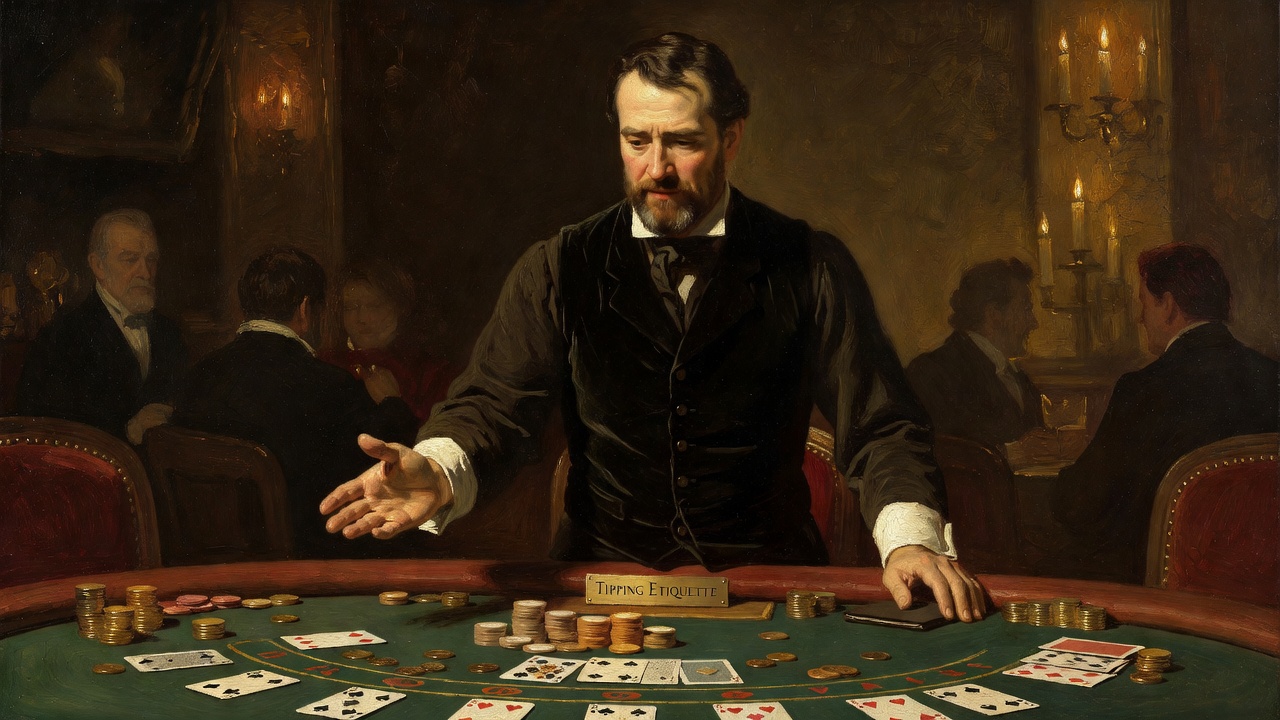
Listen. You're sitting at a table where another human being is controlling the action. That dealer is standing for eight hours. Their feet hurt. Their back aches. They're watching your cards, watching their cards, watching the pot, watching your face. That's work. That's real work.
Tipping is not generosity. Tipping is mathematics. It's the price of admission to a functioning game.
The dealer makes $2 an hour. Maybe $2.50 in better casinos. The wage is poverty by any measure. A poker room's dealer income is tips, entirely tips. That's why the dealer remembers who tips and who doesn't. That's why the pace of the game changes. A player who tips gets dealt in faster. Gets called when action's on them. Gets benefit of the doubt when the action's unclear. A player who doesn't tip gets the rule book quoted at them. Every. Single. Time.
The Structure of Tipping
Here's what the numbers tell us. Average poker hand takes 8 minutes at a $2-$5 table. Average pot is $65. A tip of $1-$2 happens once every three hands. That's roughly $1 per 12 minutes of play time. Over an 8-hour session, that's $40 in dealer tips. You're wagering $400-$800 across eight hours. The tip is 5-10% of your buy-in. That's appropriate.
For blackjack, the calculation differs. You play 60 hands per hour. You win maybe 25. You tip $1 per win. That's $25 an hour. Over 8 hours, $200 in tips. But you're wagering $1,000-$2,000 minimum. The tip percentage is 10-20%. Higher, yes. But the variance is different. Blackjack moves faster. Higher volume means higher tips.
Where etiquette collapses is at the disrespectful table. A player at a poker room in Mississippi once refused to tip. Said the dealer should get paid by the house. The dealer responded by following every rule with absolute precision. Action on you? The dealer waited. Literally waited. No rush. No help. Thirty seconds became forty. The problem wasn't vindictiveness. It was withdrawal of effort. Dealers can't refuse to serve you. They can refuse to hustle for you.
Tipping styles vary by game. In craps, you throw chips onto the table. The stickman bets them on the next roll. If the bet wins, the casino keeps it. That's a tip. You don't tip the craps crew per bet. You tip occasionally, showing respect. One $5 chip every 30 minutes of play. Same principle applies to roulette. Slip a chip to the croupier. They know what it means.
Baccarat requires a different reading. In high-limit rooms, the dealing is mechanical. The game moves by formula. A hand of baccarat is decided by rules. The dealer doesn't exercise judgment. The payouts are fixed. The ritual is pure. In a traditional casino, you tip $2-$5 per shoe won. In Macau, tipping is sparse. Players' expectations differ by jurisdiction. Honor those expectations.
Here's the moral weight. The dealer isn't trying to beat you. They're not the casino. They're a human being running a table. They want to deal a fair game and go home. Tipping acknowledges that humanity. It says: I see you. Your work matters. I respect the service. That respect circulates. When the table respects the dealer, the dealer deals better poker. When the dealer deals better poker, the game runs faster. When the game runs faster, everyone at the table plays more hands, makes more decisions, sometimes makes more money.
The alternative is coldness. A table where nobody tips. The dealer counts minutes. Moves slower. Calls hands tight when they're borderline. Doesn't help new players understand action. The game suffers. Everyone plays worse because respect is missing.
Don't tip to win. Don't tip hoping for luck. Tip because the human being across the table deserves respect for work done. Tip when you win, yes. Tip also when you lose. Tip the chip runner. Tip the brush when they get you a table quickly. Tip the server who brings water. These are people. Not machines. Casino etiquette is human etiquette. It's saying: I understand I'm part of a community. I'm not just here to take money. I'm here to participate. To respect. To acknowledge.
The last thing and mean this truly: A player who tips well changes the energy of a room. Not through superstition. Through recognition. Other players notice. The dealer notices. The floorman notices. That player becomes known. Becomes welcome. When you're welcome somewhere, when people want you there, the game improves around you. That's not charity. That's investment in an environment that serves you.
Filed under: Guides, Live Casino, Tips & Tricks